In the cosmeceutical industry, where consumers care not only about effectiveness but also place heavy emphasis on safety and reliability, product imagery plays a more important role than ever. A beautiful photo is no longer enough. What brands need are images capable of conveying functionality, demonstrating scientific rigor, and building trust from the very first glance.
So, how does cosmeceutical photography differ from other product sectors? How can images be both aesthetic and persuasive? Let's find out with M&M Communications.
Cosmeceuticals – A product category that "demands trust"
Unlike ordinary cosmetics, cosmeceuticals lie at the intersection of beauty and professional skincare. When choosing a product, consumers typically consider:
Are the ingredients safe?
Is it clinically proven?
Which skin condition is it suitable for?
Is it truly effective?
This means product imagery should not merely be for "display," but must act as an "explainer" that helps customers understand and believe in the product.
Why does imagery determine reliability?
In a digital environment, users do not have the opportunity to experience products directly. They make decisions based on:
Images
Descriptive content
Reviews from other users
Among these, images are the first element to impact perception.
A professional set of cosmeceutical photos can:
Create a feeling that the product is "trustworthy"
Convey scientific rigor and transparency
Elevate the brand image
Conversely, under-invested images can easily lead to doubts about product quality, regardless of how good the formula is.
Characteristics of cosmeceutical photography
1. Prioritize clarity and transparency
Unlike emotional beauty shots, cosmeceutical photos need:
Sharp packaging
Readable key information
Accurate product colors
Clarity helps viewers feel that the product has "nothing to hide."
2. Demonstrate scientific elements
Cosmeceuticals are often associated with:
Active ingredients
Production technology
Testing process
Images can leverage these elements through:
Lab-style backgrounds
Texture details, serum drops
Visuals simulating molecules and active ingredients
This helps increase persuasiveness and professionalism.
3. Balancing aesthetics and the “clinical look”
An effective photo set needs to be:
“Clean” enough to create a medical feel
But still “beautiful” enough to attract
If too emotional → loss of credibility
If too rigid → difficult to make an impression
Balance is the key factor.
Popular cosmeceutical photography styles
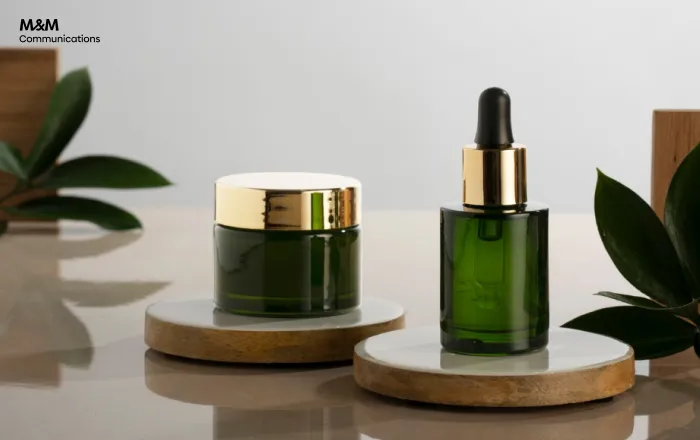
1. Clean & Minimal
White or neutral backgrounds
Soft, even lighting
Focus on the product
This style helps to:
Highlight the packaging
Create a feeling of cleanliness and safety
2. Clinical & Laboratory
Using props such as test tubes, pipettes
Sharp lighting
Cool color tones
Suitable for products:
Treatment
Specialized serum
Products with standout ingredients
3. Texture & Ingredient Focus
Close-up shots of product texture
Highlight the texture (gel, cream, serum...)
Combine with ingredient visuals
Helps viewers:
"Feel" the product visually
Understand the function more clearly
4. Lifestyle combined with Professionalism
Place the product in a real-life usage context
Combine with natural lighting
Creates a feeling of:
Approachability
Ease of application in daily life
>>> Top 5 popular product photography concepts for 2026
Professional cosmeceutical photography process
At M&M Communications, a cosmeceutical photography project typically goes through these steps:
1. Product analysis & visual direction
Research ingredients and uses
Determine the USP (Unique Selling Point)
Select the appropriate style
This is the step that ensures the images are not only beautiful but also "correct."
2. Building the concept & moodboard
Defining color and lighting direction
Selecting props and backgrounds
Aligning the overall visual
A moodboard helps clients easily visualize the result before production.
3. Setup & shooting
Establishing precise lighting
Arranging products and props
Controlling every small detail
Especially for cosmeceuticals, accuracy in color and texture is a crucial factor.
4. Post-production (Retouching)
Cleaning up images
Optimizing colors
Emphasizing product details
Post-production needs to be subtle to:
Maintain authenticity
Avoid an "over-edited" feel
5. Delivery & multi-platform optimization
Exporting files in multiple formats
Optimizing for e-commerce, social media, and websites
Helping brands use images effectively across various channels.
Mistakes to avoid
During the cosmeceutical photography process, some common mistakes can reduce credibility:
Inaccurate lighting: Distorts product colors
Over-retouching: Makes images lack authenticity
Irrelevant concepts: Do not accurately reflect the product's use
Lack of consistency: Images are not synchronized across products
These factors can directly affect customer perception.
M&M Communications – Shaping Professional Cosmeceutical Imagery
At M&M Communications, we understand that every cosmeceutical product is not just a product, but a commitment to efficacy and safety.
With experience in the fields of:
Product photography
Visual concept development
Communication content production
M&M delivers:
Clear and accurate images
Concepts aligned with brand positioning
Professional and optimized production processes
We don't just take photos; we help brands build trust through imagery.
Conclusion
In the cosmeceutical industry, where trust is the deciding factor, product imagery plays a more important role than ever. A properly invested set of photos not only makes the product stand out but also helps convey the scientific value and transparency of the brand.
If your business is looking for a solution to elevate your cosmeceutical image, start by building a photo collection that is both aesthetic and trustworthy, as it is the first touchpoint with customers.
>>> Professional Product Photography with M&M Communications