In an era where customers interact with brands across multiple different platforms, a communication campaign that only appears on Facebook or only organizes offline events is not enough to create a powerful impact. Today's consumers may see an advertisement on social media, search for information on Google, experience the product at a store, receive an email from the brand, and continue watching review videos on TikTok before making a purchasing decision.
Therefore, an IMC Campaign (Integrated Marketing Communications) has become a strategy chosen by many businesses to create a consistent experience and optimize marketing effectiveness.
So how do you build an IMC Campaign that is synchronized from online to offline? Let's explore with M&M Communications in the article below.
What is an IMC Campaign?
IMC (Integrated Marketing Communications) is a method of combining multiple communication tools and channels to deliver a unified message to the target audience.
Instead of deploying isolated marketing activities, IMC helps businesses connect all touchpoints into a seamless communication ecosystem.
An IMC Campaign may include:
Social media advertising.
Websites and Landing Pages.
SEO.
Content Marketing.
Email Marketing.
Press PR.
Influencer Marketing.
TVC or Video Marketing.
POSM.
Events and Activation.
OOH (Out-of-Home Advertising).
Point-of-Sale activities.
When all channels direct toward the same message, the brand will create strong recall and increase conversion efficiency.
Why do businesses need to implement an IMC Campaign?
Customers today no longer approach brands through a linear journey.
For example, they may:
Watch an advertising video on TikTok.
Visit the website to find information.
Read reviews on Google.
Go to the showroom to experience the product.
Receive a promotional email.
Return to purchase via the website or store.
If each touchpoint conveys a different message, the customer experience will be fragmented, reducing trust in the brand.
Conversely, when all channels are connected, customers will perceive professionalism and consistency, making it easier to remember the brand.
Step 1: Define campaign goals
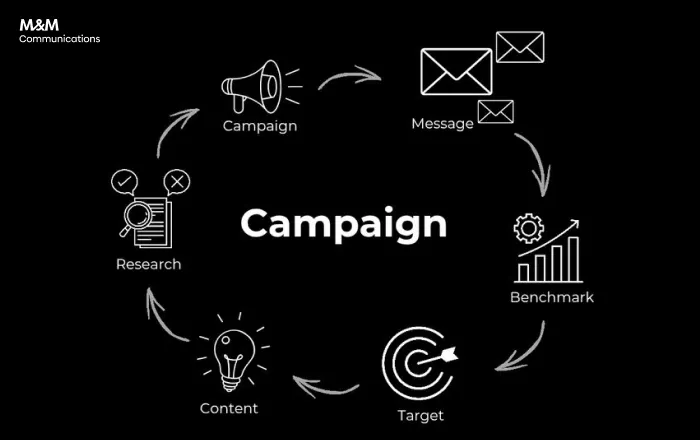
Before choosing communication channels, businesses need to clearly define the goals of the IMC Campaign.
Some common goals include:
Launching a new product.
Increasing brand awareness.
Increasing sales.
Attracting potential customers.
Building brand image.
Increasing customer loyalty.
The more specific the goals, the more accurate the selection of messages, communication channels, and measurement indicators will be.
Step 2: Clearly understand the target customer
An effective campaign always starts with the customer.
Businesses need to answer the following questions:
Who is the customer?
Which platforms do they typically use?
What influences their purchasing decisions?
What difficulties do they face?
Which message can create empathy?
Developing a Customer Persona will help the brand choose the right communication channels and the appropriate approach.
Step 3: Develop a Big Idea and a consistent message
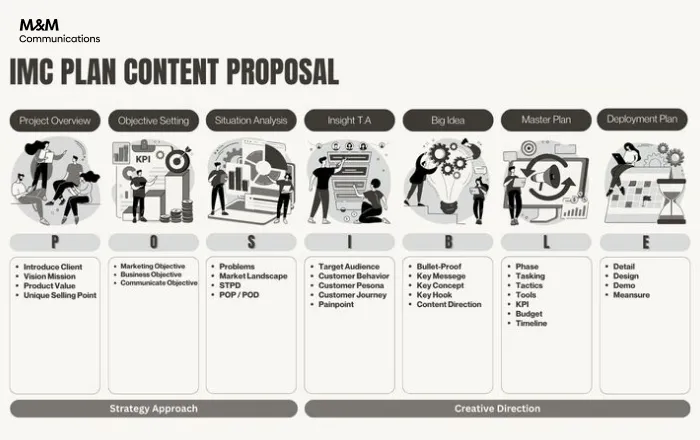
The Big Idea is the central concept of the entire campaign.
This is the element that connects all activities from online to offline.
An effective Big Idea needs to be:
Simple.
Memorable.
Aligned with brand values.
Capable of being deployed across multiple platforms.
From the Big Idea, the business develops the Key Message, Key Visual, tone of voice, and a consistent content system for the entire campaign.
>>> Customer Journey and the Role of IMC: How to Get the Message to the Right Person at the Right Time?
Step 4: Selecting the appropriate communication channels
An IMC Campaign does not mean using all marketing channels.
More importantly, it is about selecting channels that align with the goals and customer behavior.
Online Channels
Including:
Website.
SEO.
Facebook.
TikTok.
Instagram.
LinkedIn.
Google Ads.
Email Marketing.
YouTube.
Content Marketing.
This is a group of channels that help increase reach, attract potential customers, and support conversion.
Offline Channels
Including:
Events.
Activation.
Roadshows.
POSM.
Display booths.
OOH.
Sampling.
Seminars.
These activities provide direct experiences, helping customers interact with the brand more authentically.
The combination of online and offline will create a seamless customer journey.
Step 5: Synchronize imagery and content across all touchpoints
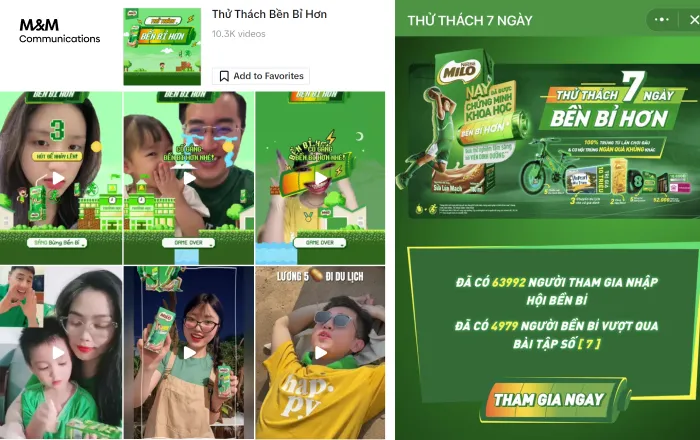
One of the most common mistakes is using a different communication style for each channel.
This makes the brand lack consistency.
In an IMC Campaign, businesses need to synchronize:
Logo.
Colors.
Typography.
Imagery.
Key Visual.
Message.
Hashtag.
CTA.
Tone of voice.
Whether customers see the brand on Facebook, a website, or at an event, they must still recognize that it is part of the same campaign.
Step 6: Measure and optimize the campaign
An effective IMC Campaign does not end once the campaign is launched.
Businesses need to track metrics such as:
Reach.
Interaction rate.
Website visits.
Conversion rate.
Sales.
Cost per lead.
ROI (Return on Investment).
Data analysis helps businesses adjust content, budget, and communication channels to optimize effectiveness throughout the campaign.
Common mistakes when implementing an IMC Campaign
Many businesses invest heavily in communication but do not achieve the expected results because:
Lack of a consistent Big Idea.
Each channel conveys a different message.
Lack of an overall content plan.
Focusing only on online or offline.
Failure to measure effectiveness at each stage.
Lack of coordination between marketing, sales departments, and implementation partners.
A successful IMC campaign does not depend on the number of channels used, but on how those channels support and complement each other to create a unified experience.
M&M Communications - Your Partner in Building Effective IMC Campaigns
At M&M Communications, we believe that a successful communication campaign is not just about creative content, but also the tight connection between strategy, messaging, and the customer experience across every touchpoint.
With an experienced team in brand strategy, content creation, design, image and video production, and multi-channel communication implementation, M&M Communications partners with businesses from the market research phase, building the Big Idea, and planning the IMC, to executing and optimizing the campaign.
In an increasingly competitive market, customers do not just remember a single advertisement or event. They remember brands that provide a consistent experience everywhere. And that is precisely the core value that a well-structured IMC campaign can deliver.